
An Early W. F. Mills Double Rifle
By Mark Brier
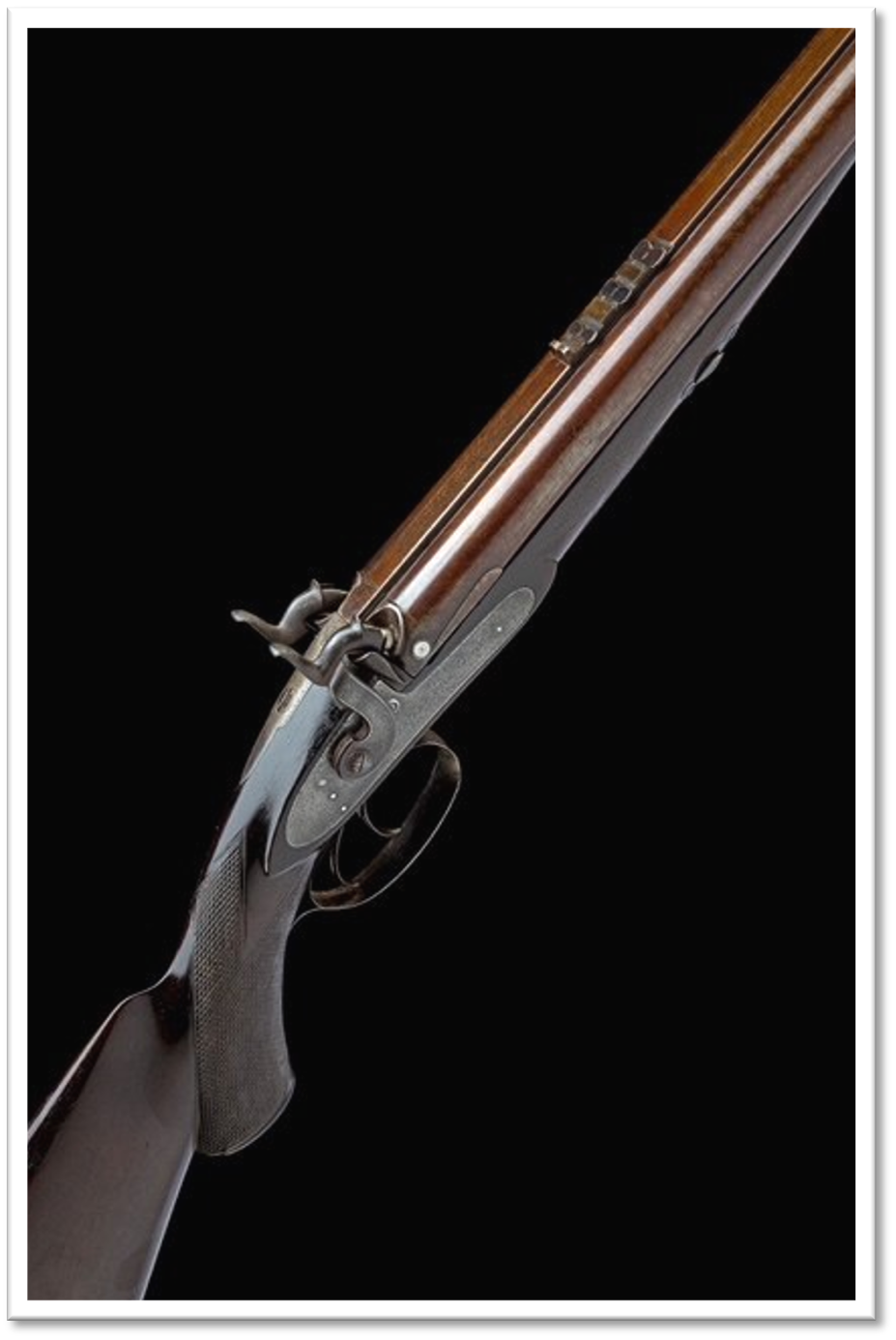
This double rifle came my way by Holt’s auction house and within a month of the auction it had crossed the big pond to reach my hands. The rifle itself is of .577 caliber with plain features but of high-quality workmanship. The maker is W.F. Mills of London as engraved on the lock plates and the top rib, with a serial number of 286.
There is little information I found of W.F. Mills. He was listed at Brunswick Square in 1821 and High Holborn 1833-1837. The shop continued after his death in 1837 as W. Mills & Son 1837-1843. The barrels are stub twist Damascus with a length of twenty-six inches, sporting a standing sight with three additional flip-up sights, with vented platinum plugs on the breeches. Why the flip-up sights on any double rifle be it muzzleloading or breechloading have always puzzled me as any flip-up sights on a double rifle are nothing but fluff and eye candy as double rifles are short range firearms used in the woods or bush.
The rifling itself is quite interesting, and I have spoken to a few friends in the U. K. about it and they themselves are uncertain and unable to put a definitive “name” on what type of rifling it is. Now this is even more interesting, as one gentleman, Ian Jackson, spent many years working for Westley Richards among other firearm-related jobs that most of us only dream about. The other gentleman I talked to about the rifling was Diggory Hadoke, who some of the readers may know by his many books or his website Vintage Gun Journal or his many videos of fine British arms.
The first two shots left me a little confused as they were not on paper and worse yet, not even on the four-foot square of cardboard the target was attached to! After some thinking and sitting at the bench studying things, particularly the sights, I determined the rifle had to be shooting high and I affixed a spotter target below the first target a good ways down. After firing the next two shots it was revealed that the rifle was indeed shooting high. 18” high at 50 yards!!! What in the world were they shooting at years ago??? After a few more rounds the rifle was shooting groups, a left group and a right group spread 8” apart. The target showed the need for more velocity, so I increased the charge to 90gr Goex 2F with the same patch and ball combination. Now we were getting somewhere, the rifle was shooting a 2” regulation and parallel. I did another session later to double check things and ran into problems. For some reason it started shredding patches and the more I shot the worse regulation got, as the shots were spreading back apart. First thing I did was look at the nipples and see that those old nipples had gotten much larger from shooting. I proceeded to put new nipples in, and the group went back to shooting 2” apart, however still shredding patches and was still 18” high.
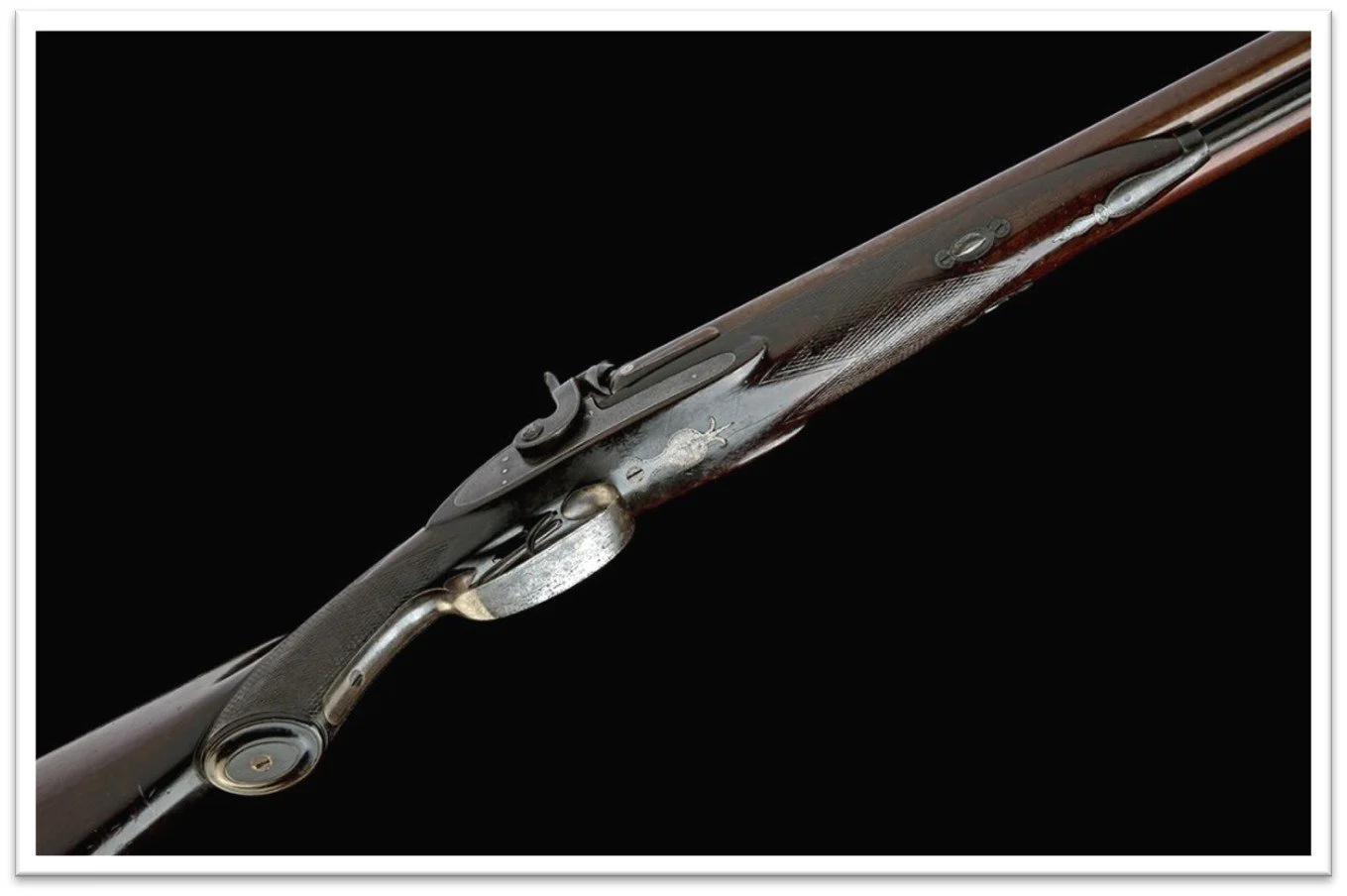
The front sight is affixed to the top rib in such a way that there was no way of changing it out without major work. The front sight was already low, but I elected to file the top of the blade square and flat and also filed a piece of steel to the same thickness as the original sight and soldered it onto the top of the original. As a precautionary, I wired and wedged the barrels from the muzzles back to the middle ramrod thimble just in case it got too hot because truth be known I had a good idea of what they soldered the barrels and ribs with but in actuality who knows what might have been used. From here forward it was a simple matter of shooting and filing down the front sight to sight it in.
Describing the rifling itself is hopefully better explained by the picture. It consists of two sets of pointed ridges that is in effect upside down triangles but of an angle that is incredibly hard to measure. Also, the rate of twist has been very hard to determine, for one the shallowness of the rifling being .005” deep. I have never been able to get a consistent number in trying to determine the rate of twist to be satisfied in saying that it is X turns in X inches. However, I can say it is a slow to medium twist. The bores had a little surface rust in them and the picture shows before any work being done. Cleaning and slicking up the bores consisted of steel wool wrapped around a tow worm with whale oil on the steel wool.
To get around the patch being shredded I went and cast some balls of .562” diameter and went up to a .020” thick. Alas we were there!! A double rifle shooting a regulation of 2” (well within the British standard of muzzleloading double rifles) and dead on at 50 yards. As a side note I also cast and shot some hollow base mini balls (out of a very old mold) that weightd 360 grains sized to .575” and pan lubed. Shooting with 70gr of Goex 2F it shoots the same as the roundball load.
First shooting session with the rifle was also interesting. The nipples appeared to be original to the rifle, and I deemed to be ok for shooting. I elected as my first shooting loading to be 70grn. of Goex 2F, with a .570” ball utilizing a .015” patch. I posted a target at 50 yards and commenced to shoot a right and a left off the bench. For those not familiar with double rifles nor shooting them, need to know that they are not bench rifles nor were they ever meant to be target rifles. They are regulated and sighted in as would be found shooting off hand, as in the hunting field. This can be done off the bench or using a standing type of rest with the larger calibers. With that said, my left hand or forearm hand was upon the rest with the forearm laying in the hand as it would be shooting offhand. By not doing so will mess with your shots something terrible and working against the natural mechanics of physical characteristics, the barrels do while shooting occurs. However, I will not go into the discussion of regulating double rifles as that is a book in itself. Perhaps best left for another article.
After the summer and fall shooting and enjoying the rifle, deer season came to Indiana. I took the double rifle out on opening morning of firearms season. The morning hunt the rifle did not get a chance to speak in the woods of the Pine Creek valley where I live. Everything I seen was just too small for me to shoot, but I was content to just sit and watch. As archery season had just ended the weekend prior, I knew the rut was in full swing as I had deer running all around me the weekend prior. Back to the house with no deer, but a wonderful morning none the less.
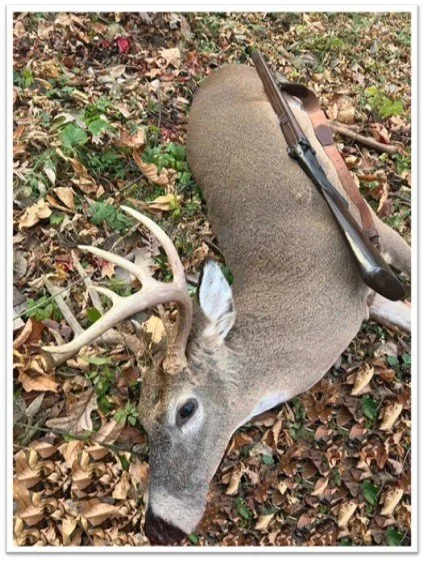
I returned to the woods at 3:00 p.m. later in the day. I didn’t have long to wait, and by 3:30 a small doe was loping towards me from further down the valley. All you hunters know the loping run a doe does when a buck is pushing her along. About 20 seconds more and here he came following. I always look at the body as I am just a meat hunter and yes, he was a good candidate. The doe passed on my right side the angled away. I whistled, I grunted and even made a pathetic bleat, but he heard none of it as his focus was on the doe. He started to pass on my right side, and I waited in hopes of him turning the same angle that the doe had. Sure enough he turned and it was a straight away shot, no matter if he was loping along or not himself.
At about 35 yards I aimed at the rear of his ribs on the right side and touched the shot off. The old rifle roared and the ball flew true as he managed to just take about 10 steps and went down. Upon dressing the deer, it was observed that the ball traveled from the back of his ribs through the lung and took out about a quarter of his heart before the ball stopped just under his skin in front of the left shoulder. Perfect!!! I couldn’t have asked for a better shot from that old rifle.
The rifle is not of a royal grade but a very sound piece of quality British gunwork. It sports just basic border engraving upon its locks and hardware, no frills, nothing fancy, just an honest working rifle that I believe a true hunter would carry and depend upon even in the most dangerous of situations. This fine double will return to the field for many more hunts, but the journey to put it back to the field at work was equally rewarding, the whole journey.
Mark Brier