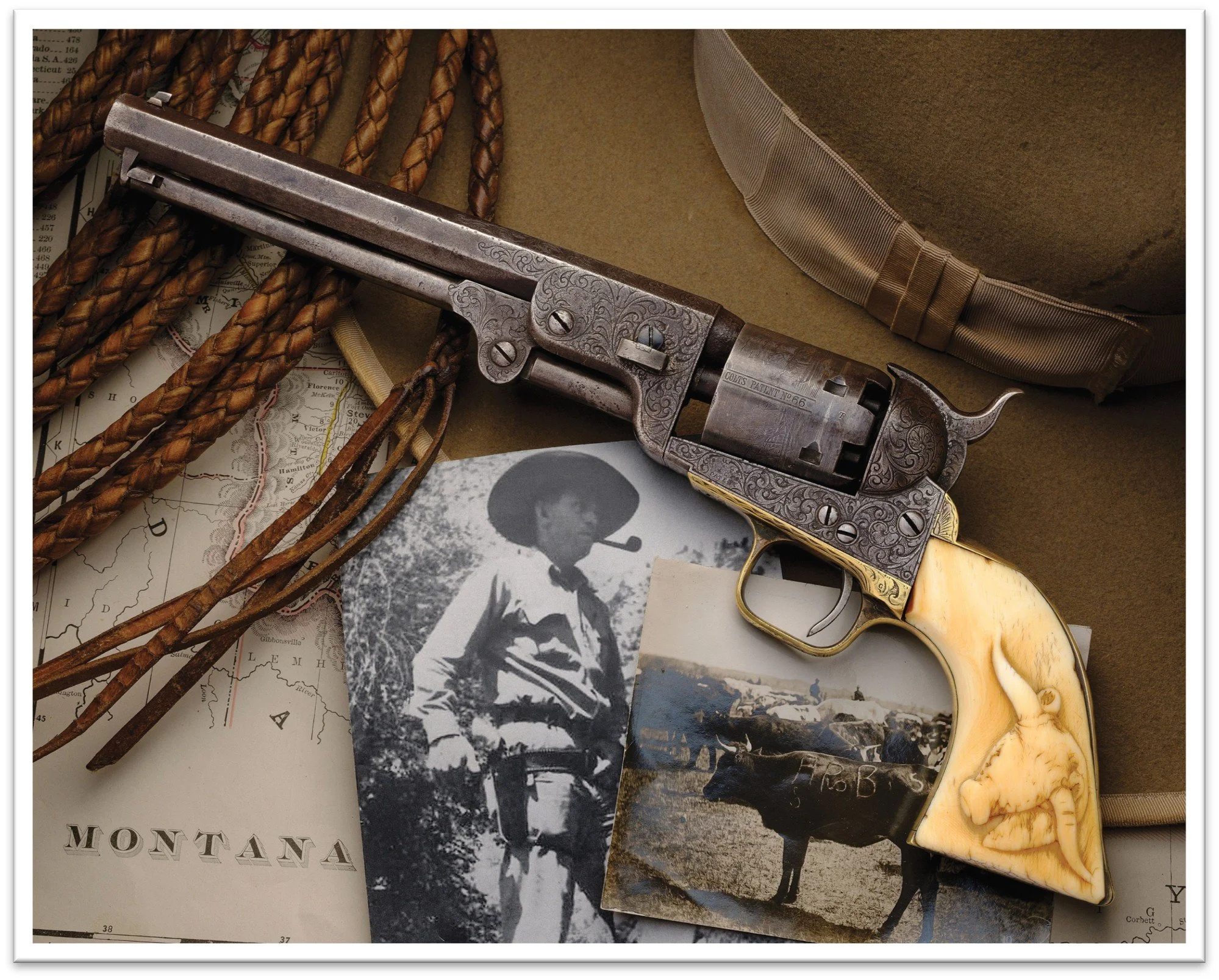
Elmer Keith’s First Sixgun
Today, those who remember the grizzled old Montana cowboy turned gun writer Elmer Keith no doubt picture his masterpiece, the .44 Magnum. Images come to mind of an ivory-stocked 4” Smith & Wesson Model 29, or the elaborately engraved and beautifully customized silhouette of the No. 5. But before all these legendary sixguns and cartridges, Elmer’s first packing gun was of a more humble nature.
At the turn of the 20th century, a young Elmer Keith began his foray into the world of revolvers with a .36 caliber Colt 1851 Navy. In his fantastic book Sixguns, he wrote, “When a boy, our best small-game revolver was an old .36 Navy Colt 1851 model. It accounted for a great many grouse, sage hens, and rabbits, both big Montana jacks and cottontails.”
He made a point that has been shared by most who have experience with Colt’s handy ’51: “Its grip was perfect for most men, and while smaller, it was much the same shape as the old Walker grip. In fact, Colt pistols show little change in grip shape from the 1847 Walker on down to the Colt’s S.A. Army, manufactured up to the Second World War. No other grip will absorb the recoil of a heavily loaded revolver with less punishment to the hand, as it simply turns up in the hand in recoil, allowing the thumb to come up over the hammer for a quick repeat shot. This design was excellent for cavalrymen and both safe and fast when a recalcitrant horse had to be managed at the same time.”
To say that Elmer’s experience with the ’51 was shaped by mentors with firsthand experience of the sixgun’s effectiveness is a bit of an understatement. Elmer was born on March 8, 1899, in Hardin, Missouri. At a young age, he and his family moved to Helena, Montana, but by the fall of 1911 they relocated to a boarding house in Missoula. One night, the boarding house caught fire, and young Elmer was badly burned. By the grace of God, he survived burns that covered most of his body, but it was a long, excruciating road. While recovering, he met an old Civil War veteran named Samuel H. Fletcher. In Sixguns, Elmer shared a story about Sam:
“My old friend, the late Samuel H. Fletcher, who served through the Civil War with the Second Illinois Cavalry, told me he emptied both .36 Navies in several cavalry fights and had to simply cut his way out with the saber. His company lost heavily on several occasions. One interesting anecdote he told me happened as follows. In a fight with the Southern cavalry, he had emptied a .36 Navy six-shooter and four shots from its mate before the fight was over. A Southern officer was turned over to him to be conducted back to headquarters and delivered to the guard. On the way back to Federal headquarters, he allowed the C.S.A. officer to retain his sidearms. They came upon a group of Federal foragers killing hogs in a brushy pasture. The boys in blue asked Sam to kill one which ran out of the brush, which he did with his .36 Navy. Soon another hog broke cover, and they yelled at him to get that one, which he also dropped with a ball back of the ear as it ran past his horse.
He said when he tipped the sixgun up to blow through the barrel to moisten the powder residue, he realized it was also empty. He told me many times he should have stopped right then and asked some of the infantry to guard the prisoner and his horse while he reloaded his sixguns. But as he had used only the one gun on the hogs, he doubted the Southern officer knew his guns were empty, so he simply conducted him back to headquarters. There he showed him his two empty Colts. The Southern officer said, ‘Suh, if I had known that, you would now be my prisoner, and we would be well inside Confederate lines.’ ‘But,’ said he, ‘I saw you drop two running hogs, and as far as I knew both your Colts were still loaded. And even though you allowed me to carry my saber and six-shooter, I knew you were a fine and fast sixgun shot, so I took no chances.’”
Elmer further told of another Civil War veteran he knew, a Confederate major named R. E. Stratton, and his experiences with the old ’51:
“My old friend Maj. R. E. Stratton, now gone to his reward, carried a beautiful pair of fully engraved and carved, ivory-stocked 1851 Model .36 Navy Colts through the Civil War, where he served with the First Texas Regiment with Lee in Virginia and elsewhere. Later he carried them for nine years of Ranger service down along the Pecos, and later over much of the West. I bought one of them from him, and when I asked him what became of its mate, he wrote me that he lost it, along with his left arm, in a gunfight in Cheyenne, Wyoming, and that one might possibly find it in or around Cheyenne somewhere. He said the gun I now have had probably seen more service as a man-killer than any Colt in existence.”
Like any shooter, both veterans had strong opinions about loads in their handguns, according to Elmer:
“Maj. Stratton said that for a man-stopper he preferred the round ball with a chamber full of F.F.G. to the pointed conical bullet. Sam Fletcher also told me he preferred a pure lead round ball in his Navy Colts, with a chamber full of black powder, to the issued conical ball loads that came in little wooden boxes of six each. He claimed the round ball dropped enemy cavalrymen much better and took all the fight out of them, whereas the pointed bullet at times would only wound and leave them fighting. He stated, however, that when foraging and shooting cattle for meat, the pointed bullet was best for body shots where penetration was needed, but that on all frontal shots on beef, the old round ball was plenty good and would reach the brain—even on bulls.”
Elmer would keep Maj. Stratton’s Colt for many years, and I’m proud to say that it’s still around. In fact, it was sold at auction in March 2015 for $13,255 and again in December 2023 for $17,625.
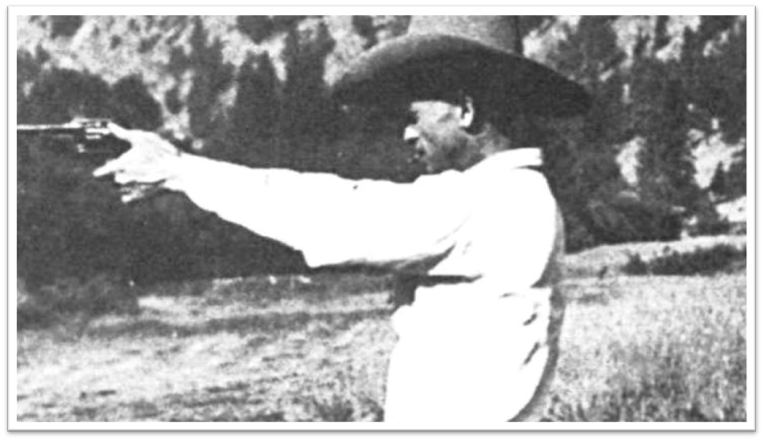
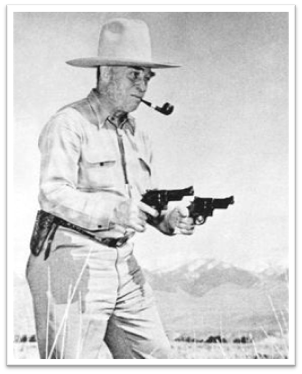
Before his death in February 1984, Elmer Keith would be the driving force in the creation of the .357 Magnum, .41 Magnum, and finally the .44 Magnum. He designed countless bullet styles, many of which are still used today and are considered among the best for their respective purposes. He served as a consultant on numerous revolver designs and is today considered one of the godfathers of the sixgun. In the foreword to his classic book Sixguns, he wrote:
“Over half a century has passed since I cut my teeth on an old .36 Navy Colt. For 40 years I have almost never been out of reach of a good sixgun. Thirty years I spent in the saddle, packing, punching cows, and breaking saddle broncs. The sixgun was worn just as regularly as my pants and many times was far more important to my existence. It pulled me out of several tight scrapes with wild horses, wilder cattle, and some big game.”
And it all started with the old ’51 Navy.